I’ve long believed a company should make decisions on four levels:
- Is this the right thing for our clients?
- Is this the right thing for our team?
- Is this the right thing for the business itself?
- Is this the right thing for the business owners?
A business that can’t, or won’t, make its clients the primary focus is a poor kind of business. Unfortunately, they’re becoming more common.
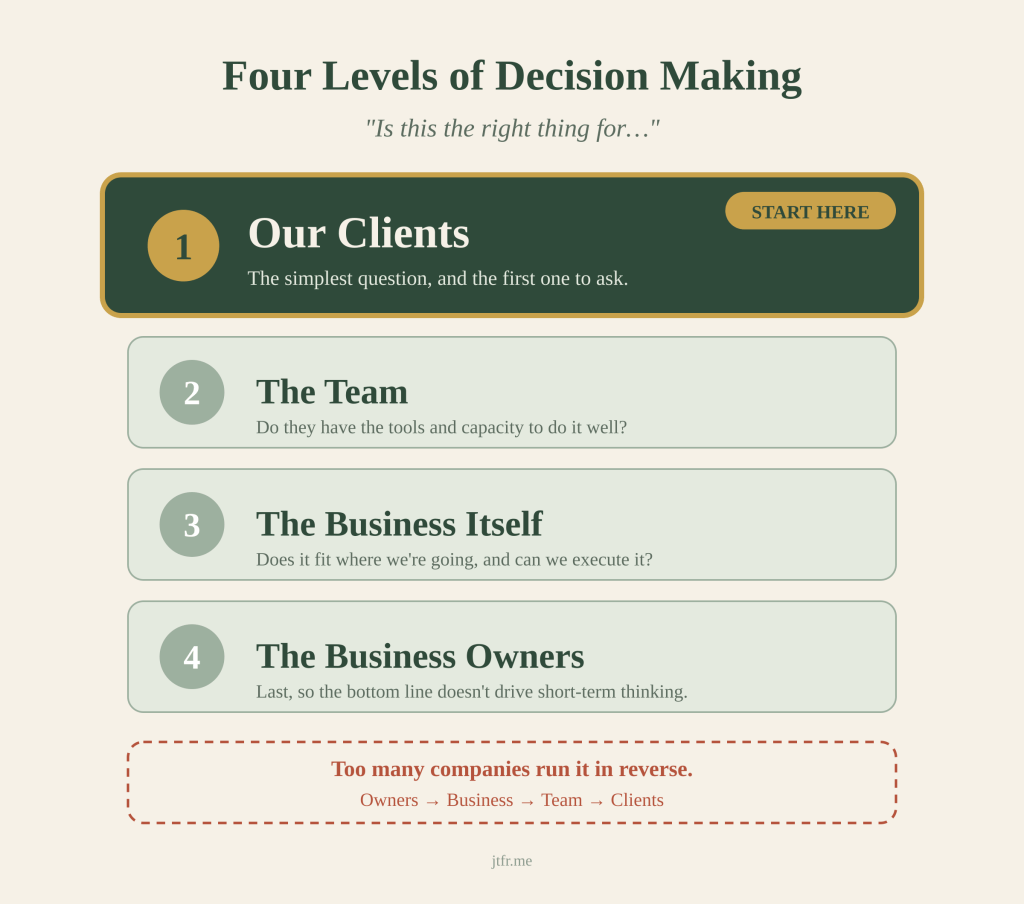
What the reverse looks like
For over a year, I’ve been working to sell my parents’ house. Their mortgage is held by one of the largest banks in the United States, one with every resource to help this go well for its clients if it chose to. In every interaction, it’s clear they run the list in reverse:
- Is it right for the business owners?
- Is it right for the business itself?
- Is it right for the team?
- Is it right for the clients?
My parents were customers for more than 30 years and still held this mortgage when they passed. We are clearly not the priority.
You can see it in how communication works. I can’t reach the service rep directly. My options are to call and wait in a queue, wait for a callback, or send a fax. In 2026. These systems are built to protect the company and its profits, not to serve longtime clients, or me, the executor and a customer of the same bank.
The kind of business I want to build
I’d rather focus on the businesses we want to build and lead. That starts with knowing who we serve.
1. Clients. Is this action the right thing for our clients? It should be the simplest question, and the answer is usually obvious once we look honestly.
2. Team. If we’re going to do this for our clients, is it right for our team? Do they have the tools they need? Do they have the capacity? Does the business or its owners need to provide more to support them?
3. The business. Is this right for the business itself? Is it aligned with where we want to go? Can we execute it, and do we have the capacity? I separate the business from its owners on purpose. The more we focus on owners and the bottom line, the more short-term our thinking becomes. We want to build long-term entities that serve far more than a couple of owners.
4. Owners. Finally, is this the right thing for the business owners? Owners come last because they benefit most when the first three questions are answered well. Clients who are well served stay and refer others. A team with the tools and capacity to serve them does better work and stays longer. A business built to last keeps producing value for years. The owners’ return follows from all of that. When it comes first, we start cutting corners on service, stretching the team thin, and trading the long term for the next quarter.
Closing
My parents were loyal to that bank for three decades, and when it mattered, it gave us a phone queue and a fax number. That is what happens when owners and the bottom line are the first question instead of the last.
I can’t change how a large bank decides things, but I can decide how I run my own business. Before we act, I want us to ask these four questions in order, starting with the people we serve. Serve the clients, equip the team, build for the long term, and let the owners benefit last. That is a business worth leading, and one worth being a customer of.
This post is AI-0 = Human. The included image is AI-5 = AI Generated.


Leave a Reply